1 72 Anigrand Aa-2081 C-141 Starlifter Kit Reviews
Anigrand 1/72 C-141A Starlifter
| KIT #: | AA-2081 |
| PRICE: | $173.00 |
| DECALS: | One pick |
| REVIEWER: | Scott Van Aken |
| NOTES: | Resin with bandage metal landing gear. |
In the spring of 1960 the Air Forcefulness released Specific Operational Requirement 182, calling for a new aircraft that would be capable of performing both strategic and tactical airlift missions. The strategic role demanded that the shipping exist capable of missions with a radius of at least 3,500 nautical miles (4,000 miles, 6,500 km) with a lx,000 pound (27,000 kg) load. The tactical role required it to be able to perform low-altitude air drops of supplies, and carry and driblet paratroops in combat. Several companies responded to SOR 182, including Boeing, Lockheed and General Dynamics .
 Lockheed responded to the requirement with a unique blueprint: the Lockheed Model 300, the offset large jet designed from the start to carry freight. The Model 300 had a swept high-mounted wing with iv 21,000 pound thrust TF33 turbofan engines pod-mounted below the wings. An of import aspect was the cabin floor's height of just 50 in (ane.27 grand) above the ground, allowing easy access to the motel through the rear doors. The ii rear side doors were designed to let the aircraft to drop paratroopers (in Baronial 1965 the type performed the first paratroop drop from a jet-powered aircraft). The rear cargo doors could be opened in flying to allow airborne freight drops. The shoulder-mounted wings gave internal clearance in the cargo concord of 10ft (iii.05m) wide, 9ft (ii.74m) high and 70ft (21.34m) long. The size enabled the Starlifter to carry, for case, a consummate LGM-30 Minuteman ballistic missile in its container. The aircraft was capable of carrying a maximum of lxx,847 lbs over short distances, and upwardly to 92,000 lbs in the version configured to bear the Minuteman, which stripped other equipment. The aircraft could also carry up to 154 troops, or 123 fully-equipped paratroopers.
The image and development aircraft then began an intensive operational testing programme including the first delivery to MATS on the 19 Oct 1964 to Tinker Air Force Base of operations, Oklahoma. Testing continued and a Federal Aviation Authority blazon certificate was awarded on 29 January 1965. The first delivery to an operational unit was on the 23 April 1965 to Travis Air Forcefulness Base of operations, California. Although operational testing continued the Air Force needs due the interest in Due south Vietnam presently had aircraft involved in operational sorties to the combat zone.
Since the airframe was shown to fill up before it reached information technology load carrying capability, about all extant C-141A airframes were lengthened 23 feet with fuselage plugs fore and aft of the wing. These were designated C-141B and part of the modification included air to air refueling capabilities. The modifications to the remaining 270 aircraft was accomplished between 1977 and 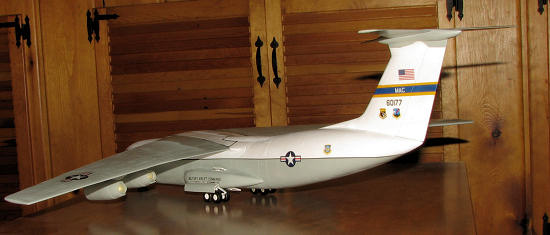 1982, effectively adding 60 airframes worth of carrying capacity to the armada.
On 16 September 2004 the C-141 left service with nearly all agile duty USAF units, beingness confined to reserve units for the remainder of its service life. As of 25 September 2005, there were only eight C-141 aircraft still flight (all from the 445th Airlift Fly at Wright-Patterson AFB). In 2004, 2005, and 2006, the C-141s stationed at WPAFB participated in missions to Iraq and Transitional islamic state of afghanistan, mostly for the medical evacuation of wounded service members.
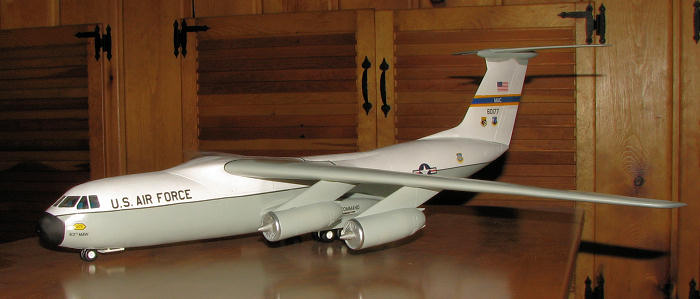
One of these last eight aircraft was the Hanoi Taxi (tail number 66-0177 and subject of this kit), which was one of the aforementioned aircraft used in 1973, for Operation Homecoming in the final days of the Vietnam State of war, to repatriate American POWs from North Vietnam. Though no longer a C-141A as it was in 1973, the Air Force repainted this aircraft in the same livery as it wore in 1973 every bit the last year of Starlifter operations approached.
With the 2006 announcement of the retirement of these terminal viii C-141s, the Hanoi Taxi embarked on a series of flights, giving veterans, some of whom flew out of captivity in this shipping, the opportunity to experience ane more flight earlier retirement. At 9:30 AM on Sabbatum, 6 May 2006, the Hanoi Taxi landed for the terminal time and was received in a formal retirement ceremony at the US Air Force Museum. The Hanoi Taxi is now part of the permanent static display collection of the Museum.
This is another monster resin kit from our friends at Anigrand. This is the brusque fuselage C-141A variant, with a virtually identical C-141B also beingness offered. In fact, all the B bits (well, the IFR receptacle) is included in this kit. Molded in Anigrand's usual tan resin with nicely engraved detailing, the kit itself is actually relatively bones. The fuselage is molded in 4 sections equally it just makes it easier to box like that. I take constitute that Anigrand'southward method of attaching fuselage sections is quite sturdy and works very well.
 The wings are upper and lower sections and pretty well free from warping, not an easy task in this scale. Pylons and engines also accept large attachment points to brand it easier to connect these items. The fin has the usual T-tail with a cardinal fairing into which the two stabilizers fit. The cockpit has a compete loadmaster station as well as the usual flight engineer, airplane pilot, co-pilot and navigator'due south positions. This is all covered by a nicely washed clear canopy. Anigrand has learned from earlier kits and provides a very nicely done set of metal landing gear. There is also sufficient infinite to cram in the weight as this one will probably demand quite a bit.
Instructions are well done with vii photograph-realistic images that prove where all the $.25 fit. Decals come from a variety of other kits including the C-117 kit with a minor sheet designed but for this particular aircraft. The decals are nicely printed and with the large, relatively flat surfaces, should work very well. Though these stick well, by experience has shown that they practice not 'snuggle down' in to the diverse console lines and crevices, even with help from setting solution.
This detail kit likewise comes with a CD that shows both interior and exterior details of the C-141 to help with the construction of the kit. The CD is only available for a very limited fourth dimension.
I would exist remiss non to mention that this kit shows the usual array of molding glitches from resin blobs to myriad pin holes and some relatively large voids, all of which will demand to exist taken intendance of if one wishes a competition level model. For that reason lonely, this kit is not for the beginner but 1 who has several of the smaller kits under their belt.
When Chris Mikesh, owner of Nostalgic Plastic/Anigrand United states told me that this kit was on its way and asked me to build one in a calendar month, my heed was somehow thinking one/144 and flush from victory over the CMR JRM Mars, I readily agreed.
Imagine my surprise when a huge box arrived a few weeks later, containing this 1/72 kit!
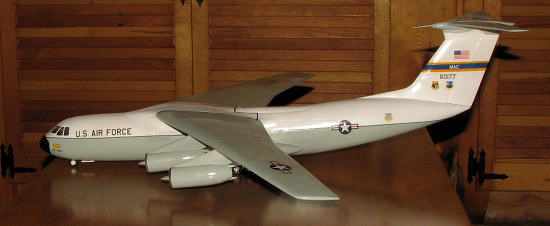 What was non surprising was that the kit was nicely detailed, simply fraught with molding faults, from newspaper thin areas on the fuselage, to voids in wheel wells, to air bubble and air pinholes, to misaligned molds, blobs of resin, and gouges where the cascade stubs had snapped off, taking part of the piece with it. Sounds horrible, but in reality, it is office and packet of many short run resin kits. These are all hand made, only made on something like an assembly line. This provides the kit at a reasonable price to us balanced against flawless resin, which would probably double the kit price. I know resin kits tin be fabricated flawlessly every bit I've built them, but they tin can been pricey. Once y'all have built several of these kits, and I remember I've probably built more Anigrand kits than most, these sorts of things are but taken equally role of the construction experience. I know this volition be a flake of a boxing, so am going to care for this WIP article as a battle match.
Round One
Before delving into what is to come, I should mention that there are several things one really needs to have when dealing with kits like this. Super glue, filler and sandpaper are a given. Items I find indispensible are:
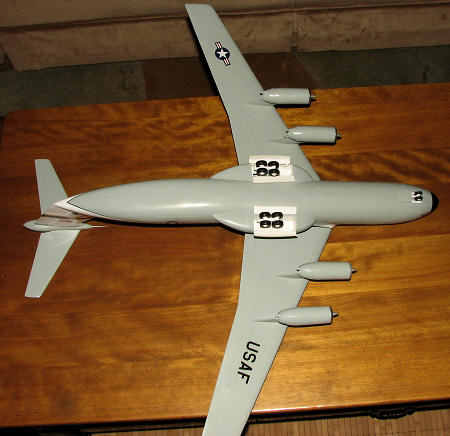 --Dull speed motor tool and attachments. I utilize a battery powered one from Micro Detailer, model 351.
--Micro files. A cheap Chinese prepare volition do just fine as it will exist very helpful for cleaning up $.25 that sandpaper can't reach.
--Paw held drill fleck set and handle. This is great for opening upwardly resin-filled attachment holes.
--Two role epoxy filler. I apply Apoxie Sculpt. The smallest size is just the ticket and will last virtually of us for many, many years.
--Sanding sticks. Get several of the really coarse grade for initial sanding. Conversely, you can utilize 180 dust sandpaper.
And so, kickoff thing is to test fit some parts and see what needs to be cleaned upwardly. I played with a few bits to brand sure they would fit, sanding off the mating surfaces and cleaning up some of the parts. When working with these large, four slice fuselages, I like to become information technology to fuselage halves offset, then mate them. So, working on ane side, I cleaned upwardly and dry fit the fore and aft section.
Hmm, quite a bit of a step between front and rear sections. Wonder if the other half is like that? Yep it is the same, providing a good sized if not huge gap in the forward fuselage. Mating only the frontwards sections to see if the canopy is too large, I constitute that in fact, the canopy is a teeny bit undersize. I did the same with the fin, finding it fit perfectly at the current rear fuselage width.
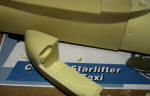 This basically ways I'll be gluing the aft fuselage, and so when that is dry, I'll mucilage the nose and use plastic carte to fill the gap. To get-go things off. I showtime glued the forepart fuselage to the aft sections, gluing it in stages to try to keep the parts aligned. Despite the gap, the alignment lugs match, which really helps out. During this stage, I figured I would attach the landing gear sponsons every bit well. Ane of these had a rather big void that needs to be filled. There was besides a small footstep on i fuselage half at the join that would demand to be sanded downward in one case the sponson was in place. Some other area that volition need taken care of are the various piffling 'dimples' that are on the fuselage halves. Almost are very slight, but some are quite deep as you lot an see in the image. These things can be taken intendance of with standard filler. The large void and large dimples volition be all-time treated with epoxy filler every bit information technology does not shrink when drying. Epoxy filler is not practiced for shallow repairs as it needs depth to stick well.
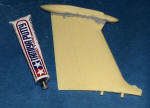 I filled the sponson's gap with Apoxie Sculpt, smoothing to near the last contours to lessen afterward sanding. I also took my motor tool and sanding sticks to clean up the various major parts. This meant the wings, fuselage halves, sponsons, tail and speed fairing. The speed fairing was suffering from mold misalignment. I decided to attach it to the fin before dealing with the alignment problem. Yous tin can see the step in the photograph to the left.
With the fuselage halves together, I practical filler to the joins and when dry, sanded those down. Then the sponsons were attached. I found them to be a bit larger than the mating surfaces. I chose to match things upward on the underside as that would be the area most easily seen. The inner engines volition cake much of the upper sponson surface area and that is where I chose to exercise most of the filling. I also glued the wings together. This was done in stages since they are so long. As usual, at that place were a number of air holes on the tip and so I applied additional super glue there to help fill up them.
Filler work on a kit like this is usually all-encompassing. Sometimes information technology tin easily consume 1/3 of the build time. Since I'm under a fourth dimension constraint, I decided only to bargain with the most egregious glitches and leave the small ones to fend for themselves. This meant that I'd be limiting myself to four rounds of filler and sanding. Sounds like a lot, but it seems that one always finds something that needs corrected afterward each circular. Fortunately, the amount needed each time is less and less. Once circular ane was applied, I stopped and let this dry out before continuing.
Round Two
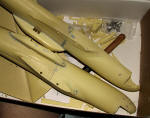 As you might have guessed, the time since the last update has been spent reapplying filler and after a day'southward drying, information technology is sanded down and reinspected. I give these volatile fillers a full day to dry out and so that I won't be surprised subsequently by sunken down sections. The photo you run into of the fuselage bits to the right, is later on the third application of filler and sanding. In that location is at least i more to go as some of these are a chip on the deep side. In retrospect, I should have used epoxy filler on the upper sponson join surface equally information technology was deep enough where this material would accept proven useful. Aforementioned on the large air void on the nose, but one more awarding will surely take care of it. As well, I still haven't joined the fuselage halves and in that location will exist more than filler needed there. The wings also had their 2d awarding done and cleaned. This was generally on the leading edges and on the wing tips, the latter having more than their off-white share of holes.
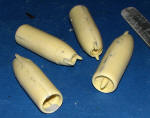 During this fourth dimension I also joined the engines. This was a bit more than time consuming than I'd originally anticipated thanks to some major resin blobs on the rear of one of the engine halves that took considerable time to
 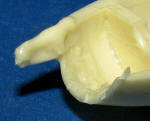 grind abroad so that the exhaust would fit. I found that one has to install the exhaust piece during mating the engine halves, but not the compressor face (though I did gum one in anyway). This will make information technology much easier to clean up the inner intake seam.
I know this does not seem like a lot of progress for two days, only such is the instance when dealing with this sort of matter. My focus following this volition be on the cockpit as that needs to be done before I can bring together together the fuselage halves. Stay tuned.
Circular Three
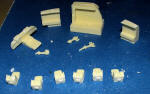 Now it was on to the interior. Anigrand provides what are basically shapes for the various consoles. They also give you 6 somewhat generic seats and I was blessed with three command sticks. First thing was to grind out the resin gunk in the attachment holes in the floor. I too had to grind away at the dorsum of the big item you see in the upper center to become it to fit properly. When working west
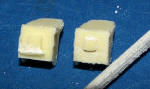 ith these bits, information technology is a good thought to take a set of fine files. These were particularly handy when it came to cleaning up the underside of the seats as the resin pour stub was particularly invasive. I then painted the floor of the interior in dark gull greyness using a lighter gray for the sidewalls and bulkheads. I also painted the diverse consoles. The seats were gray with a blue cover and the principal instrument panel and console were black. I was able to get all the bits in place without likewise much trauma, though all of this took a considerable amount of time. I left off the main instrument panel and command sticks which will be installed simply prior to attaching the clear bits.
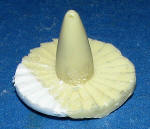 In betwixt filing and letting paint dry out, I got an due east-mail that told me that the engine fans were set besides far back in the nacelles. Sure plenty, my own 141 photos showed that these were near flush with the front of the engine nacelles. Anigrand has them set up way back. Well, I'd already glued i in the set place, but was determined to remove it and put it in the proper location. Of cours
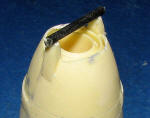 e, I couldn't get it all out and snapped off a bit of it. Nothing to practice merely make a replacement so I superglued and section of plastic carte du jour and when dry, filed some blades. It isn't pretty , but will be better than nothing.
I besides did more than filling and sanding on the engine nacelles. The thrust reverser link covers on several of these had large air pockets. 1 way to fix some of these was to install a section of plastic rod and when the glue dries, it will be sanded downward and more filler practical to polish things out. The only other option would be to trim the fairings down, or to cut off the protrusions and replace them with plastic bill of fare.
I besides did more filler and filing applications to the fin fairing, fuselage and the wings. I know this doesn't sound like much, simply all of this does accept time to allow filler dry out and all that stuff.
Round Iv
I know that some would like daily updates on this, but the truth is that much of the fourth dimension, as mentioned earlier, is taken up with filling and sanding. Pretty boring stuff.
Anyway, I did ge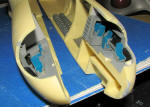 t the majority of the cockpit $.25 painted and in place. I left off a few until only earlier putting on the clear bit as I know I'll break something if I don't. I also installed what I hoped would exist enough weight. Several long weights a bit farther back and two big sections of canvass lead placed just behind the cockpit and formed to the fuselage sides. You can only see this lead on the correct side of the prototype. I know the cockpit isn't fancy, but I'm also non sure how much detail will be visible through the transparency. Those that wish, could add paper or tape belts to the mix.
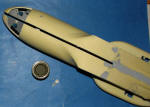 At this time, information technology seemed as if joining the fuselage halves together would be a adept idea. With long resin parts like this, it is best to mucilage in stages so that things can line up equally best as they can. Fifty-fifty then, I fully expected to use a lot of filler and shimming. As you can see from the image, there is a considerable gap in the frontward fuselage halves. Though it looks bad, this is non that unusual. The owner of CMR told me that depending on the temp and humidity of the twenty-four hours parts are cast, it was not unusual to go wide variances in parts' sizes. He says he only tries to friction match things up equally all-time he can and permit the builder deal with the rest. That is the reason for the 'experienced' modeler' labels on these kits.
Regardless, it will have more time and work to correct this. I put a standard paint tinlet in the photo for a comparison. I decided that before tackling the forward one-half, I'd get the rear every bit proficient as I could. Usual sanding and filling and I installed the vertical fin at this fourth dimension too and so I could become it smoothed in. Downside of this is if information technology is off, I'm doomed (and I'one thousand pro 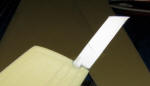 bably doomed to alignment problems anyway as it seems to exist my biggest cross to behave when it comes to any model). I also took this time to make clean upwardly the tail planes. No real problems aside from a large void on the tip of i. This one too had a big low well-nigh the root, but an piece of cake make full. For the tip, I cut information technology even larger and into a rectangular shape. So I placed a section of formed plasticard into information technology and filled information technology with superglue. This is standard stuff so is a skill that should be learned. Oftentimes times information technology is easier to merely cut out the area of interest and replace it with plastic card than endeavor to fill up a myriad of holes. I besides continued to piece of work on the engine nacelles with filler and such.
Round V
OK, I should be a bit farther along than I am, but with the holidays and all.....
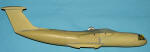
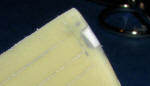 Anyway, I have been working on some of the smaller parts of the kit while fixing the large stuff besides. I did terminate the tailplane section every bit yous tin see from the image to the right. I besides glued the forward fuselage, making sure that the cockpit area was properly mated. This is to ensure minimal additional work getting the transparency to fit. This squeezing did crusade some cracks in the fore/aft fuselage join that was fixed in one case
 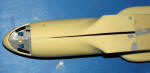 the front of the fuselage was filled and there was no more flexing. Fortunately, the frontward fuselage section is long enough to allow this. On the C-141B kit at that place will be even more length to help out.
To fill the fuselage, I used sections of the thickest plastic carte du jour that I had. First, the motorcar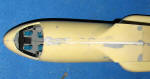 d was trimmed in a similar mode every bit I did with the previous repair. Past having a larger 'tab', it prevents the section of bill of fare from falling into the fuselage and makes information technology easier to handle. For the really wide function, I had to double up the carte. Thinner sections were used for other parts of the gap, all installed in a similar manner of trimming to size first, then installing. I then flooded the card to menu join with cement and the rest of the area with super glue. Unlike the nose, I did not utilise accelerator and permit the super gum dry usually. This provides a stronger bond with fewer pits.
Of course, one and so has to cut off what are rather thick sections of card and then polish things down. Not exactly an easy task and I went through a coarse sanding stick in no time while doing this! Even so, later several days of work (one needs to call up that this was on both the pinnacle and the bottom of the fuselage) I got things to a respectable level. It also put me onto my 2nd tube of filler. Once that was done, the instrument panel/console and the command yokes were glued in place.
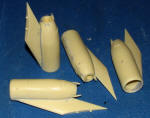 Meanwhile, I returned to the engines and attached them to their pylons. For all of the diverse attachments, I accept found that I needed to drill out the mounting holes. Basically, they are non deep enough and in some cases are too small. I was fortunate enough to take the advice of my practiced friend Drew at a show ane yr, and spent the funds on a set of drill $.25 that went from #59 to #ane. This has made much of this work and work on other kits then much easier equally I have found I utilise a lot of bits in the 50s and 40s on diverse models.
Adjacent upward, attaching the awning and work on the landing gear.
Round 6
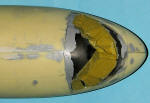 This time, I first masked the awning and then fastened it using clear pigment. Once that had dried, I added a flake of superglue for force. As mentioned before, the canopy itself is a bit undersized so several coats of filler were needed to endeavour to smooth things in. Still wasn't quite as much equally I'd have liked. As a suggestion to Anigrand when they do things like this, it would be nice to have more room to work with in terms of having
  more 'airframe' every bit part of the articulate bits. Having an additional 1/4 or one/two inch away from the window parts would have been a huge help. Anyway, that was finally smoothed as best as I could get and this pretty well left me with a consummate fuselage. It was now time to get some painting washed.
Early C-141s were in ADC Greyness FS 16473 with a white upper fuselage and fin. The tailplanes, wings and engines were all ADC grey. When I went looking for my favorite Model Master enamel, I found that Testors no longer makes ADC Greyness, but now calls information technology Light Aircraft Grey. As usual, I mixed this with lacquer thinner to reduce the drying time. On an airframe this large, painting takes considerable time and I spent most of the last several days doing piffling more than spraying on paint.
One time most of the ADC grey was done, I started to spray on the white, choosing to concentrate on the fin/rudder and doing some 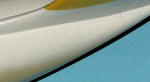 on the upper surface also. Spraying on the white (Testors Model Chief enamel gloss white), showed a myriad of pin holes on the aft fuselage. I'm non sure just whether I'll go through all the work to fill those or not. Once the white fin had properly dried (and this stuff really takes a adieu and a half before 1 should handle it), I masked off the upper/lower demarcation line. I also had to mask off the fin band. Anigrand does not supply this as a decal (though I think they should). Nonetheless, there are prominent lines showing where this band goes. I fudged a bit to the inside during this process every bit one also has to paint the yellow surroundings. The underlying white volition make this piece of cake once the blue department is painted. I should mention that there are no wing walk decals provided either. This will exist a VERY long undertaking as stripe decals of decent length are very difficult to locate. So far, I've had no success beyond short sections of Microscale railroad decals.
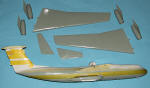 Getting back to things, I masked off the items equally mentioned, also masking off the area under the tailplanes. I all the same have to add more masking to forestall overspray and I have to deal with cleaning upward and painting the wheels and gear doors. I did gum in the nose gear and the resin piece that goes with it. Apparently this resin fleck is supposed to adhere to the nose gear, but if so, the zipper stubs are too brusque or missing. I but glued information technology in and then it looks properly busy. Once that was in and dry, I sprayed all the gear wells. There is overspray, just since I've still got some greyness to do, this will exist touched up during that time.
Round 7
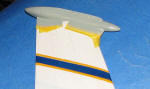 Still in with the painting. As you may surmise, painting something this large, and with gloss enamel paints, is not a quick effort. However, I did manage to paint the fin band (I think the colors may be a bit likewise bright) and apply several sessions of topside gloss white during this time. Last night, I was able to practice touchup on the ADC grayness underside and tail tip. This required me to mask off the wheel wells, a somewhat complex task. I also
 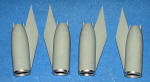 painted the intakes to the engines using Alclad II polished aluminum. These did turn out nicely.
While waiting for the paint to dry out, I 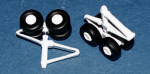 also assembled the master landing gear. Bare Metallic Foil was wrapped around the oleo and the main wheels were drilled out equally the mounting holes were either besides minor, as well shallow, or filled with resin. There was some mold shift on several wheels and so a bit of boosted sanding was needed on them. These all had the hubs painted gloss white so the tires were brush painted with Floquil'due south Engine Black. They were glued to the struts with somewhat dull drying super glue. As the wheels are non all perfectly circular nor of equal width, some fudge room needs to be allowed to motility them around so that all 4 wheels will touch. I got them pretty close and will sand the bottom of them later on.
I still have half-dozen days in which to assemble and adhere the wings, engines, gear, gear doors, and tailplanes. I also have to exercise something about painting the nose and anti-glare panel and install the engine faces at the proper depth. Decals need to be done also. It will be close.
Round Eight
In the last several days, I've been basically working on finishing upwards the painting and doing some pocket-size associates and decal work.
First affair I did was to mask off and paint the nose radome matte black. Then, looking at photos, I discovered that an area I left unpainted for the nose anti-glare panel needed to exist left white as the 141 did not have one of these. After the paint dried on the olfactory organ, I masked information technology off and the grey below information technology to apply a couple of coats of white.
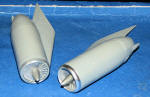 As that was drying, I returned to the engines to see what could be done about the compressor depth. As you can, hopefully, see from the photos, Anigrand has them also far back when they should exist almost up to the engine intake lip. Fortunately, the fit is a chip tight so information technology was piece of cake to glue these in place. One has to be careful on this as the inlet 'spike' is not molded at 90 degrees to the fan blades so information technology is like shooting fish in a barrel to get things out of line. Better to accept the blades a flake off than an off-kilter inlet spike.
Finally, the paint was dry enough for some decals. One has to find an alternate source for the stripes and I used Microscale sheet 91102, three" and 4�" Black. Y'all can get these from whatever place selling trains. Y'all'll probably have to order them. There are not enough to exercise both the fuselage and wing walk stripes you need to order two sets if you want to do them all. The 3 inch stripes are about the right size for the 141. Unfortunately, I was totally unable to get a full stripe on the aeroplane equally each one was determined to 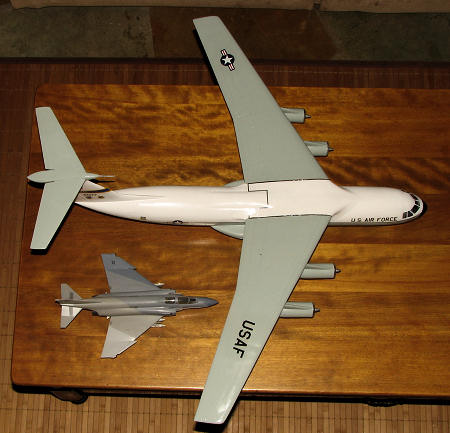 interruption down into several pocket-size pieces. Equally this was a new sheet, I can simply surmise that bodily decal canvass had been sitting in a warehouse for many years before being installed in a new package.
It made putting on the stripes a two 24-hour interval job as I'd put on a goodly department on both sides, and then carefully utilize Microsol before setting it aside to fully dry. The next day I added the residuum of the stripes.
When those were dry out and settled plenty to handle, I fastened the landing gear. The nose gear had been glued in for quite a while, so I just glued on the nose wheels. The openings for these are considerably larger than the beam, so I needed to use accelerator on the glue. Be sure to exit a scrap of a stub sticking out.
The main gear were non difficult to adhere and over again, I used accelerator to go them into initial position. The mounting brackets don't seem to be in perfect alignment with each other or the well as looking from the bottom, the wheels would striking the sponsons on retraction. Yet, few will see this so it is no worry. It likewise seems that the kit gear were molded from an unloaded museum aircraft as they sit a bit high. There should be a section of the strut sticking up through the top of the sponson where there is a door to let proper clearance. The kit gear exercise not. Fixing this would accept time and cut on the metal gear and so I left it as it is.
 I then started putting on the fuselage decals. These are well printed as are all Anigrand decals. The white is semi-transparent so the MAC on the tail badge has bleed through as does the white star on the insignia where the fuselage ring goes through it. The yellow on the various badges too nearly disappears one time the decal is applied. I'yard thinking that these should be outlined in black, but am non positive. I also noticed that the unit proper noun is "63th MAW" instead of "63rd MAW". A problem one can find when a kit is made past people who don't speak English equally their main language. I also was a bit disappointed to find that the red cantankerous for the fin was not included as a decal. Painting this would be a job and I only did not have the fourth dimension for information technology so left it off.
So I'thousand into the abode stretch and have three days to add together gear doors, wings, tailplanes and a few other sundry parts as well as a few more decals and the inevitable bear upon up painting. Stay tuned.
Last Round
Well, I didn't think I'd make it, but accept been lucky, I guess. The final steps were not as simple as 1 would take wished, but such is the style of things. I started off this last run past attaching the gear doors. As was expected, the fit of the chief doors wasn't bad, simply not that good either. The doors curve at the attachment points, but the sponsons don't. Anigrand patently didn't spend much time in inquiry as the inner doors practice non hang straight down, just fold upwards nearly flat confronting the bottom of the fuselage. 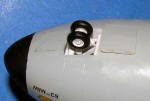 One has to do some work to remove hinges to get a proper fit. The nose doors are something that also requires work. Showtime of all, the forward doors remain closed except during gear cycling. I glued those in place, finding the expected gaps. These were not filled due to time constraints. The rear door is not at all the 'hang from the edge' design that is molded. This slice slides down and back, once more fitting tight confronting the bottom of the fuselage. Don't make the mistake of cutting on these doors beforehand as it will only add together to your work load when yous have to c
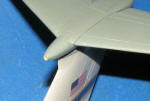 ement them back together. Do remove the hinges before painting. I besides glued on the minor upper sponson doors in a slightly open position. Normally the strut would push these doors upwards, but as the strut is molded extended, it won't accomplish that high. Before adding wings I also figured it would exist a skillful fourth dimension to drill out the tip of the fin to accept the resin pitot probe.
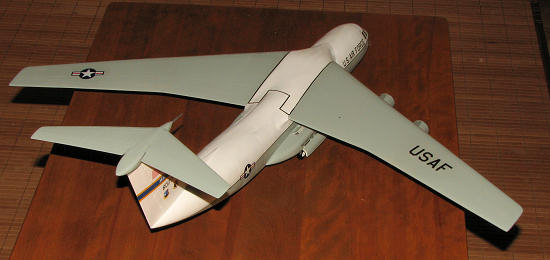
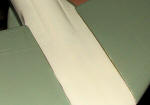 With the doors in identify (and be very careful not to break them off during handling) it was time to attach the wings. Non an easy task due to the size of the kit and several things became credible. One is that the fit wasn't as nifty as I'd have hoped. When I'd finished attaching the ii wings, there were some gaps at the height of the wing. Two options. One was to break out the filler and get to work. Merely I didn't have the time to spend several days working on that and besides, I'd probably interruption something else. So I chose option two and that was to crook. I cheated by getting somewhat wide black stripe decals and pretending there were blackness dividing lines. These stripes were also added in a fake walkway pattern but to add to the illusion. Though the gaps are still there, the black lines attract attention away from them and they seem to disappear. I should also point out that ane has to sand the inner trailing border of the wing to a rounded shape in order to get it to fit. Conversely, one could carve into the small fairing that is there.
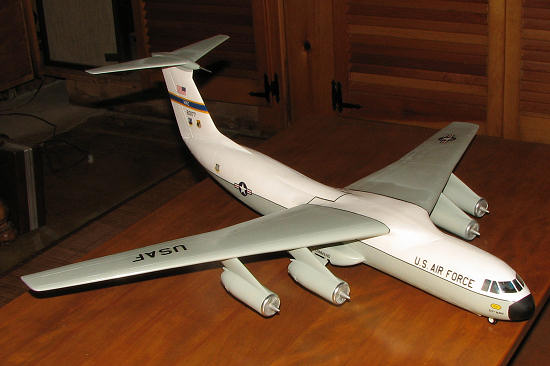
Next were the engines. Fit here is as to be expected. They don't fit well and the angle is decidedly 'downhill'. Again, considering of time constraints, I did nil to fix this, simply information technology does crave reshaping of each of the upper portions of the engine pylon in order to remove the nose down attitude of the engines. This should also assistance to go rid of the gap that is in that location in the stock position. The last steps were to attach the tail planes, which actually fit rather well, and then gum on the pitot tube. I so removed the masking from the windscreens and that was information technology.
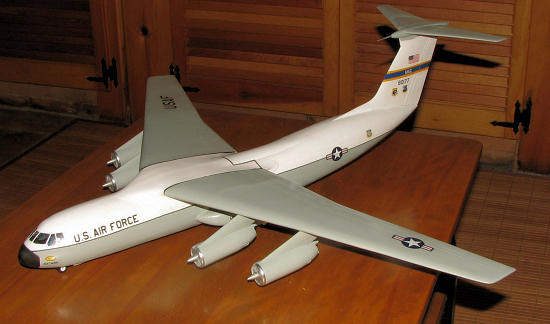 So there you accept information technology. A resin ane/72 C-141A in 28 days. Was it worth it. Certainly. Equally much as I fuss about the work these kits require, to me, this is more like modeling than merely gluing and painting some wunderkit . There are challenges to overcome, one gets to stretch one'south skills, and the end result is a model that few others will have in their collection. It likewise re-taught me not to build things co-ordinate to a fixed fourth dimension table, something I volition not do once again. Had I not agreed to do so, I'd have stock-still several of the glitches that I let pass (such every bit the myriad pinholes on the fuselage, the wing gap and the engine pylons), only so, it would accept taken me three or four months to complete.
I highly recommend these kits to those who are ready to stretch their skills to the next level. You'll be glad you delved into these sorts of kits.
http://en.wikipedia.org
July 2008
Copyright ModelingMadness.com. All rights reserved.
If yous would like your product reviewed fairly and fairly quickly, please contact the editor or meet other details in the Note to Contributors .
Back to the Main Page
Back to the Review Index Page 2020
Source: https://modelingmadness.com/scott/mod/us/c141.htm
Belum ada Komentar untuk "1 72 Anigrand Aa-2081 C-141 Starlifter Kit Reviews"
Posting Komentar